Build vs. Buy
Why Off-the-Shelf Software Leaves Your Business Gaps Exposed
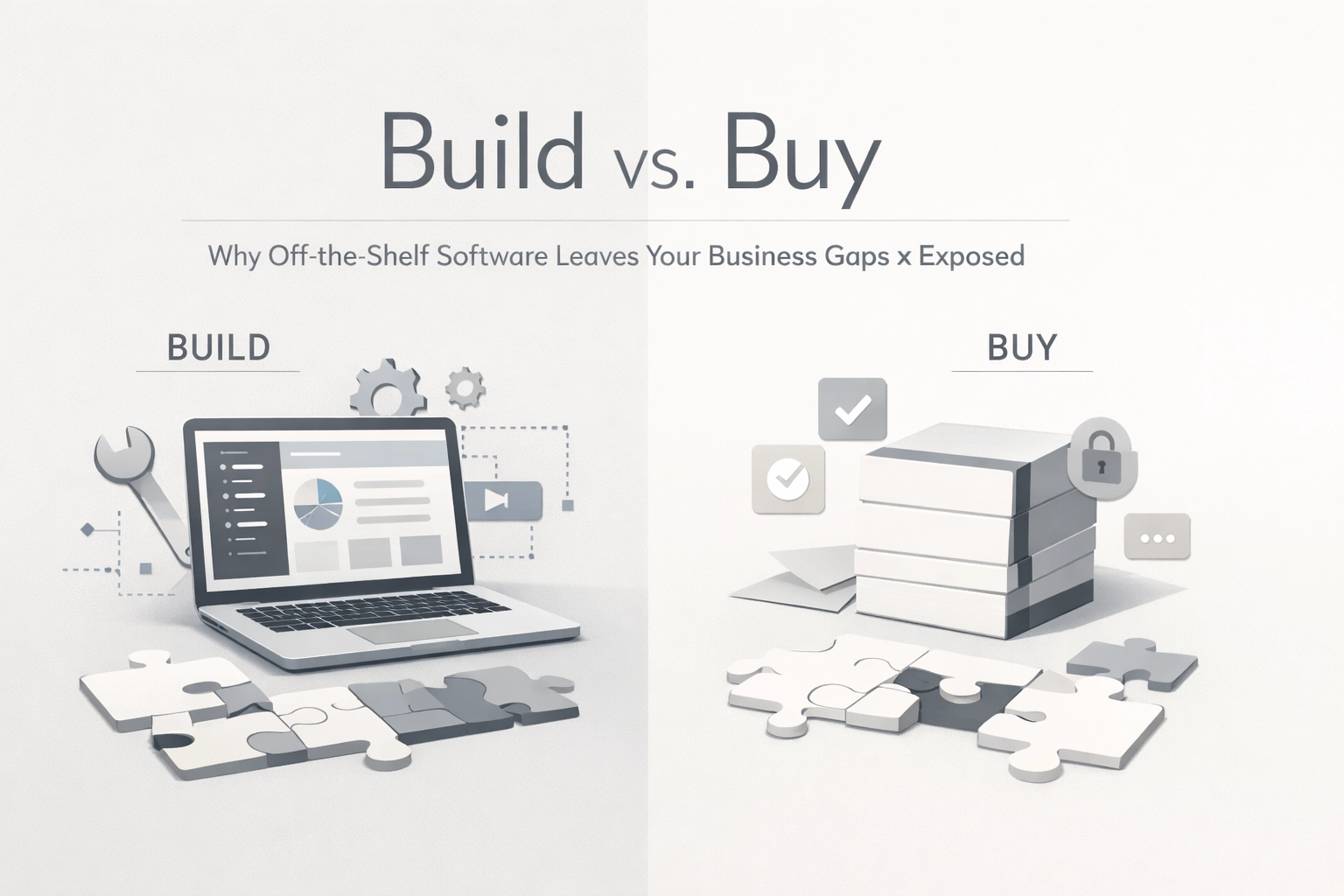 The choice between building custom software and buying a pre-packaged solution is a fundamental business decision. Most organizations prioritize speed and lower initial costs. They choose off-the-shelf software. This decision often results in unforeseen long-term limitations. Off-the-shelf software is designed for a broad market. It addresses general requirements. It does not address unique business processes.
Fortivex is a custom software development company. We focus on practical delivery. Our approach eliminates the gaps created by standardized tools. When a business adapts its processes to fit a tool, efficiency is lost. When a tool is built to fit the business, performance is optimized.
The Reality of Off-the-Shelf Software
Off-the-shelf software serves the median user. Software vendors build features that appeal to the largest possible audience. This strategy ensures the vendor’s profitability but ignores the specific needs of high-performing organizations. Companies that rely on these tools often find themselves at a disadvantage.
Standardized applications require concessions. You must adjust your internal workflows to match the software’s architecture. This is an inversion of proper business logic. Technology should serve the process. The process should not serve the technology. When organizations force this alignment, they create friction.

Identifying the Concession Gap
A concession gap occurs when a software limitation forces a manual workaround. These gaps are often small at first. Over time, they accumulate. They become significant operational burdens.
Common concessions include:
Manual data entry between incompatible systems.
Inability to generate specific, high-value reports.
Rigid user interfaces that slow down employee productivity.
Lack of integration with proprietary legacy systems.
Off-the-shelf tools leave these gaps exposed. They lack the flexibility to evolve with your specific operational changes. Fortivex identifies these gaps through rigorous analysis. We ensure that your software covers 100% of your business requirements, not just the 80% offered by commercial products.
The Role of Digital Product Strategy
Practical delivery begins with a clear digital product strategy. This is the phase where business goals are aligned with technical requirements. Many firms offer theoretical advice. Fortivex offers a roadmap for execution.
A successful strategy identifies where off-the-shelf products fail. We examine your current workflows. We find the points of friction. We determine how a custom solution will provide a competitive advantage. This strategy ensures that every feature developed serves a concrete business purpose.

Our strategy phase covers:
Market and competitor analysis.
Process mapping and bottleneck identification.
Technical feasibility assessments.
Long-term ROI projections.
By establishing a firm strategy, we avoid the "feature creep" that often plagues enterprise projects. We focus on what is necessary for your success.
Precision Through Digital Product Design
Once the strategy is defined, we move to digital product design. This is not merely about aesthetics. It is about functional architecture. Off-the-shelf software often has cluttered interfaces. These interfaces contain features you do not need and will never use.
Custom design removes this clutter. We build interfaces tailored to your specific user roles. Every button and every workflow is intentional. This focus on design reduces training time for employees. It minimizes errors. It ensures that the software is an asset rather than a hurdle.
Fortivex prioritizes user experience as a driver of operational efficiency. Our design process is iterative. We validate designs against real-world scenarios to ensure they perform under pressure.
Practical Delivery: Digital Product Development Services
The core of our value is found in our digital product development services. We do not just design; we build. Our development teams focus on high-quality code and robust architecture. We use modern technology stacks to ensure your application is fast, secure, and scalable.
Custom development allows for deep integration. Your new application can communicate seamlessly with existing tools. This eliminates the data silos common in off-the-shelf environments. We build for the Modern World. This means prioritizing cloud-native solutions and mobile-first accessibility.

Our development process is transparent. We provide regular updates. We demonstrate progress through functional builds. We deliver software that works on day one.
Scalability in Enterprise Application Development
Large organizations have complex requirements. Enterprise application development requires a focus on security and scalability. Off-the-shelf software often struggles with high volumes of data or complex permission structures.
Fortivex builds enterprise applications that grow with your business. We account for future expansion during the initial build. This proactive approach prevents the need for costly migrations later. Custom software is an investment in your company’s future infrastructure.
When you own the code, you own the roadmap. You are no longer dependent on a third-party vendor’s release cycle. You decide when to add features. You decide when to scale. This level of control is essential for maintaining a competitive edge.
The ROI of Custom Software Development
The initial cost of custom software is higher than a monthly subscription. However, the total cost of ownership is often lower. Off-the-shelf software carries hidden costs. These include:
Per-user licensing fees that increase as you grow.
Costs associated with manual workarounds.
Integration fees for third-party connectors.
The cost of lost productivity due to inefficient workflows.
Custom software development company partnerships like those with Fortivex eliminate these recurring drains on your budget. By building a tool that matches your process exactly, you recover lost hours. You improve data accuracy. You increase your overall throughput.

Eliminating Process Gaps with Fortivex
Fortivex exists to solve business problems through technology. We do not provide generic solutions. We provide tailor-made applications. Our focus is on practical delivery. We turn your business requirements into functional digital products.
The choice between build and buy is a choice between leadership and conformity. Buying off-the-shelf is an act of following the market. Building custom software is an act of leading it. You define the rules. You own the process. You eliminate the gaps.
If your current software is forcing you to make concessions, it is time to evaluate your options. Gaps in your process are gaps in your profitability.
Take Action: The Process Gap Audit
Most businesses are unaware of the total cost of their software concessions. They accept friction as a standard part of doing business. Fortivex offers a different perspective.
We invite you to schedule a Process Gap Audit. In this strategy session, we will:
Review your current software ecosystem.
Identify specific areas where off-the-shelf tools are failing your team.
Outline a high-level roadmap for a custom solution that closes those gaps.
Stop fitting your business into a box. Build the box that fits your business.
Visit Fortivex to learn more about our approach.
To understand more about how we prepare businesses for the future, read our article on being AI-Ready or AI-Stuck.
For a complete overview of our services, return to our homepage.
Fortivex. Practical Delivery. Modern Results.

Greg Guido è un executive revenue leader, stratega della crescita e sviluppatore di leadership con la passione di favorire il successo aziendale. In qualità di fondatore e CEO di Fortivex, aiuta le organizzazioni a ottimizzare le operazioni di revenue, a creare team ad alte prestazioni e a creare strategie di crescita incentrate sul cliente.
Con esperienza di leadership presso Formidable (acquisita da NearForm), Inoapps, The Hackett Group e Oracle, Greg ha guidato team su larga scala e attuato strategie di trasformazione del go-to-market. Ha conseguito un B.S. dalla Northern Illinois University e un certificato di Chief Revenue Officer dalla Booth School of Business dell'Università di Chicago.
Oltre agli affari, Greg è attivamente coinvolto negli sport giovanili e nelle organizzazioni comunitarie. Attraverso i suoi scritti, condivide approfondimenti sulla crescita dei ricavi, sulla leadership e sulla strategia aziendale, aiutando le aziende a orientarsi nel mercato in evoluzione di oggi.